Understanding Spam Rentals & Fraudulent Charges
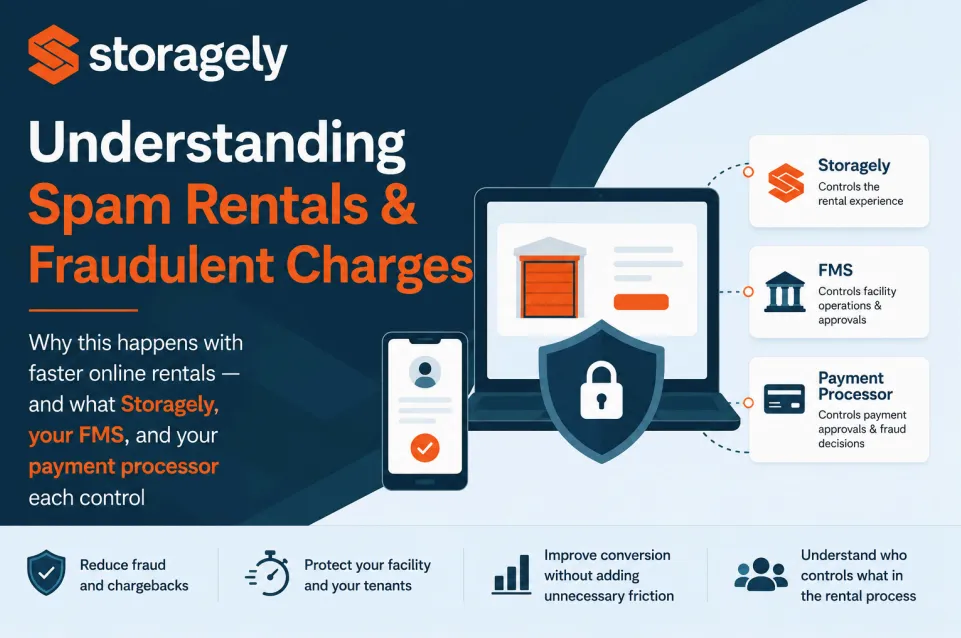
Why this happens with faster online rentals
When it becomes easier for good customers to rent online, it also becomes easier for bad actors to try. Older self-storage rental systems usually had 3 to 6 pages creating more friction. That extra friction slowed down both real renters and fraud attempts.
Our newer one-page checkout makes renting faster and easier, similar to modern eCommerce like Shopify. This improves conversion rates and helps more real customers complete rentals.
But less friction also means:
- More spam rentals
- More bot activity
- More stolen card attempts
- More fraudulent charges
This is normal across eCommerce. Most industries deal with this every day.
The difference is that self-storage has traditionally relied on slow, multi-step rentals, so many operators are seeing this challenge for the first time.
The 3 Systems Involved
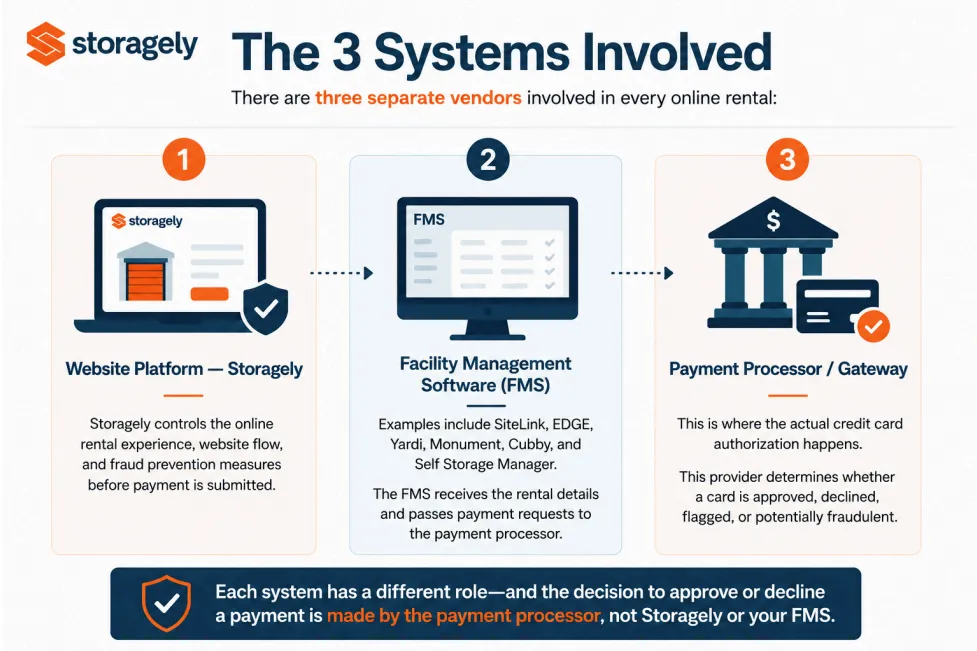
There are three separate vendors involved in every online rental:
- Website Platform - Storagely
- Storagely controls the online rental experience, website flow, and fraud prevention measures before payment is submitted.
- Facility Management Software (FMS)
- Examples include SiteLink, EDGE, Yardi, Monument, Cubby, and Self Storage Manager. The FMS receives the rental details and passes payment requests to the payment processor.
- Payment Processor / Gateway
- This is where the actual credit card authorization happens. This provider determines whether a card is approved, declined, flagged, or potentially fraudulent.
Important: Storagely Does NOT Process Credit Cards
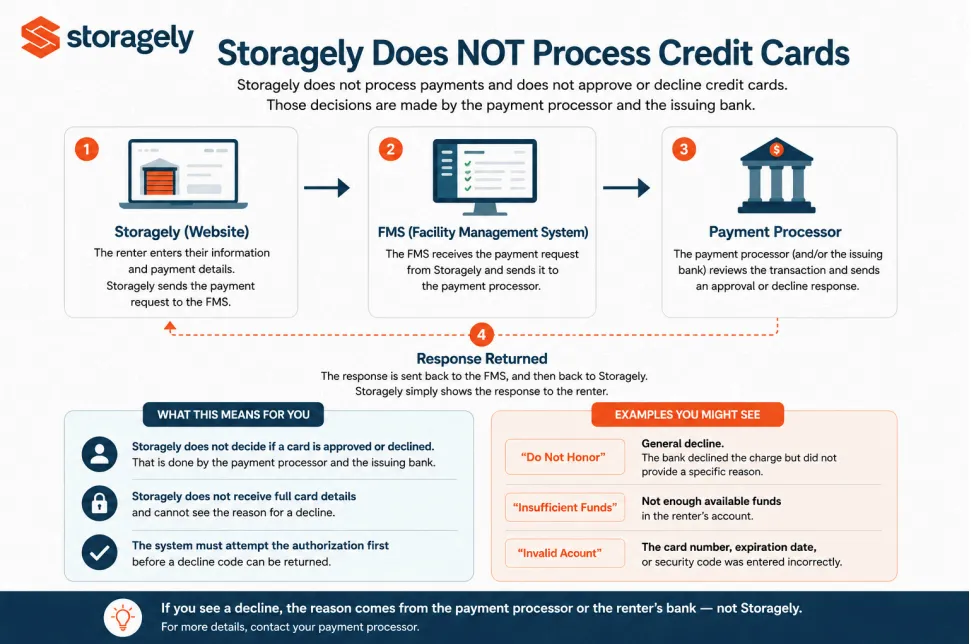
Storagely does not run credit cards, approve payments, decline payments, or make fraud decisions. We handle the online rental experience and send the payment request through the system.
Here’s how it works:
- Storagely (Website) → FMS → Payment Processor
- Then the response comes back:
- Payment Processor → FMS → Storagely
Who decides if the card is approved?
The payment processor and the renter’s bank make that decision, not Storagely.
They decide if a card is:
- Approved
- Declined
- Flagged for fraud
- Blocked for security reasons
Example: “Do Not Honor”
If you see a decline message like: Do Not Honor
This message is coming from the payment processor or the customer’s bank. It does not come from Storagely. It usually means the bank declined the charge but did not give a specific reason.
Important to know
The system must try the payment first before a decline code like this can be returned. That means the card was submitted for authorization, and the processor or bank made the final decision.
What Storagely Already Does to Reduce Fraud
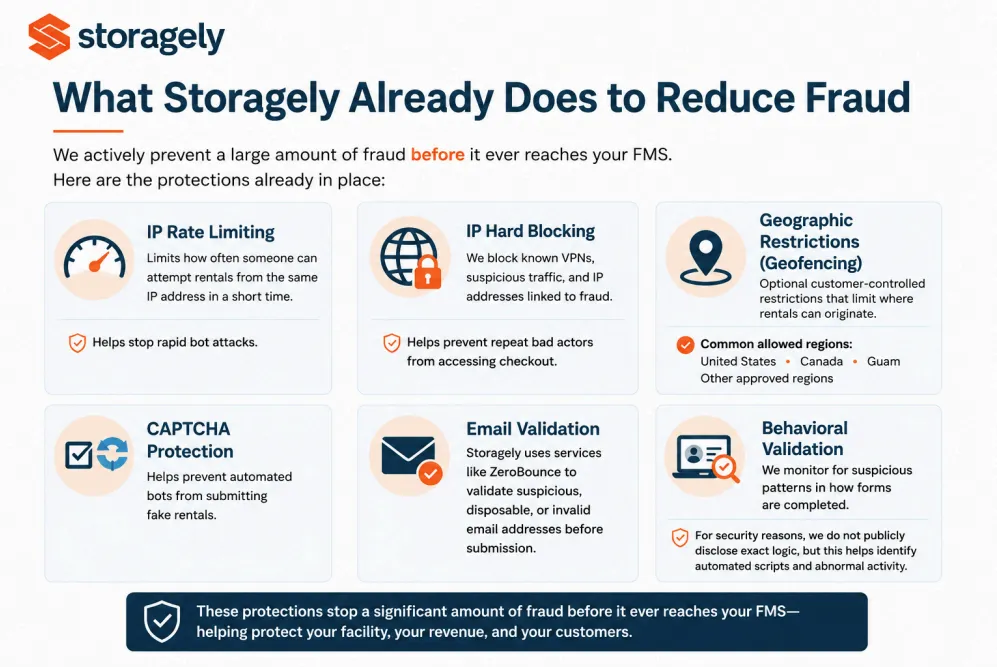
We stop a large amount of fraud before it ever reaches your FMS. Here are the protections already in place:
- IP Rate Limiting
- Limits how often someone can try to rent from the same IP address in a short period of time. This helps stop rapid bot attacks. More aggressive limits can block more fraud, but if set too high, they can also block real customers.
- IP Hard Blocking
- We block known VPNs, suspicious traffic, and IP addresses commonly linked to fraud. This helps stop repeat bad actors from reaching checkout.
- Geographic Restrictions (Geofencing)
- Optional location-based restrictions that control where rentals can come from. Common approved regions include:
- United States
- Canada
- Guam
- Other approved regions
This helps reduce international fraud attempts.
CAPTCHA Protection
- Helps stop automated bots from submitting fake rentals.
Email Validation
- We use services like ZeroBounce to detect fake, disposable, suspicious, or invalid email addresses before a rental is submitted.
Behavioral Validation
- We monitor for unusual patterns in how forms are completed. This helps identify bots, scripts, and suspicious activity before checkout is completed. For security reasons, we do not publicly share the exact rules behind this system.
What Storagely CANNOT Detect
There are important limits to fraud prevention:
- We Cannot Know if a Card is Fraudulent Before Authorization
- Only the payment processor can determine this. A card may look valid until an authorization attempt is made. That fraud signal comes back from the processor, not from Storagely.
- Sophisticated Fraud Can Look Human
- Modern fraud tools and AI can simulate legitimate browser activity and human behavior. This makes some fraud extremely difficult for any platform to detect. This is an issue that ALL E-commerce platforms deal with on a daily basis.
Additional Protection
(With Conversion Trade-Offs)
While there are more aggressive fraud prevention measures we could implement, each additional layer of security creates a direct tradeoff with conversion rates. Stronger restrictions often introduce more friction for legitimate customers creating longer checkout times, more verification steps, failed validations, blocked transactions, and increased abandonment during the rental process.
In self-storage, where speed and convenience are major drivers of online rentals, too much friction can significantly reduce completed move-ins from real customers. The goal is not simply to block every possible fraudulent attempt, but to create the right balance between protection and conversion, stopping bad actors without making it harder for legitimate renters to do business with you.
What Customers Should Also Review
Fraud prevention is not only a website issue. Your FMS settings and payment processor settings are equally important. We strongly recommend reviewing:
Payment Processor Fraud Rules
Examples:
- AVS verification
- CVV requirements
- Velocity checks
- Address matching
- High-risk transaction flags
- Country restrictions
Many processors allow stricter fraud screening that may not be enabled by default.
FMS Configuration
- Some FMS platforms allow additional payment validation settings or approval workflows. These should be reviewed with your FMS provider.
If Fraud Happens, What is Next?
If a fraudulent rental gets through:
- Step 1: Contact Your FMS Team
- They can help reverse the rental and identify what transaction occurred.
- Step 2: Contact Your Payment Processor
- They control refunds, chargebacks, and fraud review decisions. They can explain processor response codes and card authorization outcomes.
- Step 3: Contact Storagely
- We can review the following to see if any further improvements can be made:
- Rental source
- IP history
- Fraud patterns
- Additional blocking opportunities
- Geofencing recommendations
- Checkout behavior review.
Final Takeaway
Faster checkout improves rentals. But faster checkout also requires stronger fraud management.
This is not a failure of the website, it is a shared responsibility across:
- Website Platform
- FMS
- Payment Processor
The goal is not to eliminate all fraud (which is impossible). The goal is to reduce fraud while still allowing real customers to rent easily.
That balance is where strong operators win.